
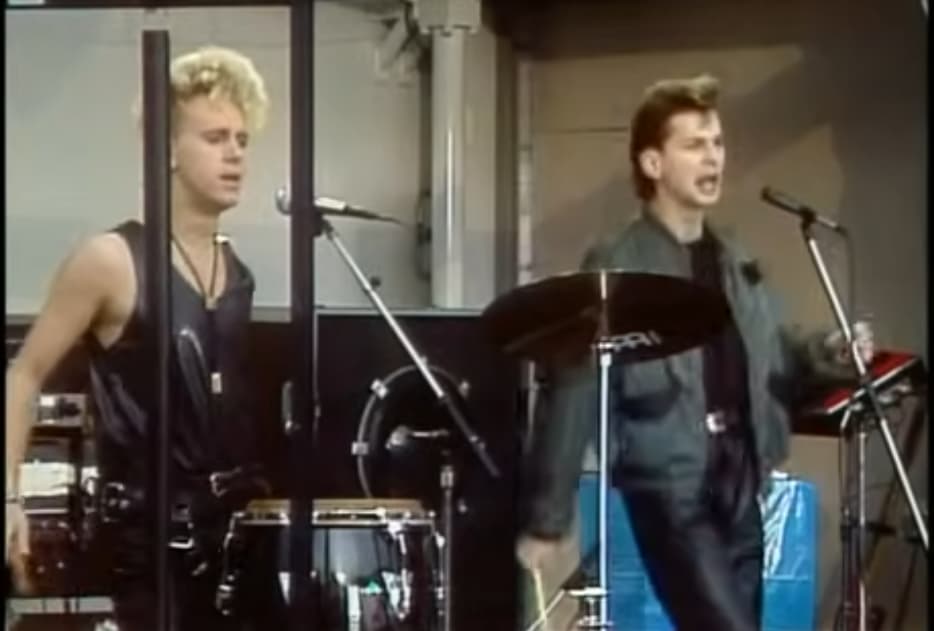
Depeche Mode in 1984: The Rare Performance That Captured People Are People at the Beginning of a New Era
Before Depeche Mode became one of the defining electronic bands of the 1980s, there was a period when their sound was still developing rapidly. A rare German television performance of People Are People from 1984 offers a fascinating glimpse into that transition, capturing the group at a moment when their electronic identity was becoming sharper, heavier and more distinctive.
The performance was filmed in Schleiden, Germany, for the German television program Musik Convoy. The program featured Depeche Mode alongside several other international acts, and the episode was broadcast in April 1984. The appearance came only weeks after People Are People was released as a single on March 12, 1984.
The timing is important. People Are People quickly became a major breakthrough for Depeche Mode. It reached number four in the United Kingdom and became the band’s first single to reach number one in West Germany. The song also introduced a more forceful rhythmic character that helped separate Depeche Mode from many of the lighter electronic pop acts of the period.
Watching this early performance today, it is easy to understand why longtime listeners continue to describe it as special. The arrangement is driven almost entirely by electronic instruments and rhythm, yet it has a physical intensity that challenges the idea that electronic music must sound cold or distant.
Alan Wilder’s presence is particularly important. He had joined Depeche Mode in 1982 and became increasingly influential in shaping the band’s recorded and live sound. Fans often point to his rhythmic precision and technical approach when discussing performances from this period. However, it is important not to reduce the band’s sound to one member. Martin Gore was the principal songwriter, while Dave Gahan’s voice and stage presence became central to Depeche Mode’s identity. Andy Fletcher also remained an important member of the classic lineup.
The performance also captures something that modern footage cannot easily reproduce. The band is still young, the production is relatively simple, and there is little of the enormous visual spectacle that would define their later stadium years. What remains is the music itself.
People Are People would eventually become one of Depeche Mode’s best known early songs, helping push the band toward a much larger international audience.
More than forty years later, this rare television appearance remains valuable not because it shows Depeche Mode at their commercial peak, but because it documents the band while that identity was still being formed. It is a snapshot of Depeche Mode before global superstardom, when four musicians were building the sound that would soon become unmistakably their own.