
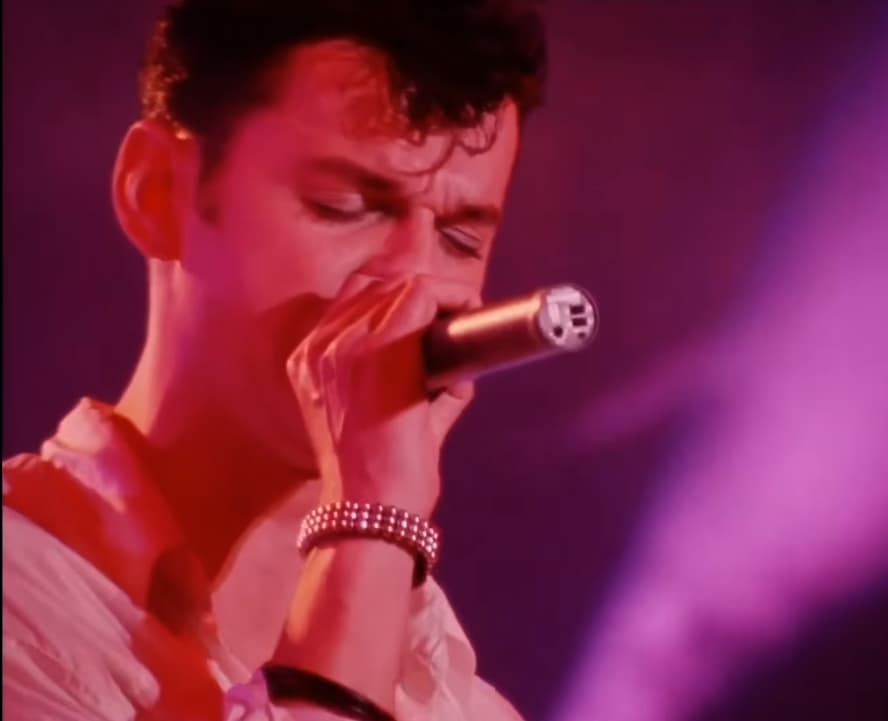
The Night Depeche Mode Turned a Stadium Into One Giant Wave
On June 18, 1988, Depeche Mode walked onto the stage at the Pasadena Rose Bowl for the final show of their Music for the Masses Tour. More than 60,000 people were there. What followed became one of the defining moments in the band’s history, immortalized in the documentary 101 and the live recordings that followed.
Among all the performances captured that night, Never Let Me Down Again remains especially powerful.
The song had already become one of Depeche Mode’s most striking compositions, but the Rose Bowl performance revealed what the band could achieve in front of a massive audience. Rather than relying on conventional rock spectacle, Depeche Mode built its impact through electronic sequencing, layered keyboards, rhythm and the commanding presence of Dave Gahan.
Then came the moment that fans still remember.
As the song reached its climactic section, thousands of people began moving their arms together. What might have looked like a simple gesture from the stage became one of the most recognizable images associated with Depeche Mode. Gahan later recalled seeing people waving their arms and joining them, only to find the gesture spreading across the enormous crowd. The image became closely associated with the song and with the 101 film.
Alan Wilder was another crucial part of the performance. His contribution to Depeche Mode’s sound went far beyond simply playing keyboards. His approach to rhythm, sequencing and electronic arrangement helped give the band’s live performances a physical weight that could fill a stadium without depending on a traditional rock setup.
That quality is one reason fans continue to describe this version as unusually powerful. For listeners who discovered Depeche Mode through their records, the Rose Bowl footage demonstrated something important. The band did not need to abandon electronic music to command a massive American stadium. They could take synthesizers and programmed rhythms and make them feel enormous.
The significance of the night went beyond one song. Depeche Mode’s official history describes 1988 as a pivotal moment when the band finally broke into the American mainstream. The Rose Bowl was the 101st and final date of the tour, marking the culmination of a period in which the group moved from alternative venues toward major arenas and stadiums.
Released in 1989, 101 preserved that moment for another generation. Yet its lasting power is not simply about nostalgia. It captures the relationship between four musicians and an audience discovering, together, how powerful electronic music could become in a live setting.
Decades later, Never Let Me Down Again still carries that sense of occasion. The technology may have changed, but the image remains unforgettable: Dave Gahan on stage, Alan Wilder shaping the rhythm, and an entire stadium moving as one.