
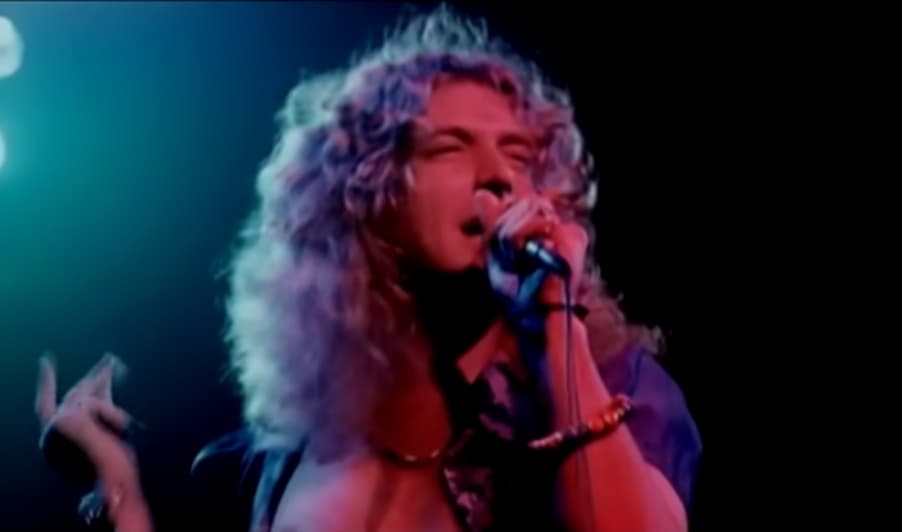
The Night Led Zeppelin Turned “Black Dog” Into Pure Live Electricity
Some rock performances are remembered because they were technically perfect. Others survive because they capture a band at the exact height of its power. Led Zeppelin’s performance of “Black Dog” at Madison Square Garden in July 1973 belongs firmly to the second category.
Filmed during the band’s legendary three night stand in New York, the performance later became part of The Song Remains the Same, the concert film released in 1976. The footage preserves Led Zeppelin during one of the most important periods of its career, with Robert Plant, Jimmy Page, John Paul Jones and John Bonham operating with the confidence of a band that had already become one of the biggest forces in rock music.
What makes “Black Dog” particularly interesting is that its famous riff did not originate with Jimmy Page. John Paul Jones developed the main riff and later recalled writing it down on the back of a train ticket after returning from a rehearsal at Page’s house. The idea was influenced by the blues, including music Jones had been listening to from Muddy Waters. The complicated rhythm initially proved difficult for the entire band to play together, forcing them to simplify the arrangement before arriving at the powerful version audiences know today.
The title has its own unusual story. During the recording sessions for Led Zeppelin IV at Headley Grange, a black Labrador was reportedly wandering around the property. The dog became associated with the song’s title, although it had no direct connection to the lyrics themselves.
By the time Led Zeppelin reached Madison Square Garden in 1973, “Black Dog” had become an explosive concert piece. The song appears near the beginning of the filmed set, following “Rock and Roll” and “Celebration Day,” immediately establishing the aggressive energy of the performance. The surviving footage also shows something that studio recordings cannot fully communicate: the physical interaction between four musicians responding to one another in real time.
That is ultimately what makes this performance valuable today. It is not simply a famous song being played on a famous stage. It is a document of Led Zeppelin functioning as a complete musical unit, with Jones’s intricate bass foundation, Bonham’s enormous rhythmic presence, Page’s guitar work and Plant’s commanding vocal performance occupying their own essential space.
Decades later, “Black Dog” still sounds powerful because the performance was never built around one musician alone. It was built around four musicians listening, reacting and pushing each other forward.
That may be the real reason this footage has endured. It captures Led Zeppelin not as a legend looking back, but as a living band at the height of its powers.